
blastFoam vs. Experiment & ANSYS Fluent at Mach 6
Technical Summary
This work is a 3D CFD validation study of an aerospike-protected hypersonic missile dome run in blastFoam with the k-ω SST turbulence model. The geometry, freestream conditions, and pressure-tap layout follow the canonical Huebner et al. wind-tunnel experiment (AIAA 95-0737, NASA Langley 20-Inch Mach 6 Tunnel) — a hemispherical dome on a 4-inch cylindrical body fitted with a 12-inch aerospike/aerodisk assembly along the axisymmetric centerline. We compare our surface pressure predictions against both the experimental data and the ANSYS Fluent results published by Rao, Viti, and Abanto (AIAA 2020-2123).
Freestream and Case Conditions
Freestream Mach number: 6.06
Static pressure: 1,951 Pa
Static temperature: 58.25 K
Angle of attack: 10°
Working fluid: air, non-reacting, Sutherland viscosity, ideal-gas thermo
Turbulence model: k-ω SST (compressible)
Solver: blastFoam (transient, compressible)
Mesh
The mesh is generated with blastFoam's blockMesh2D utility, which builds a 2D axisymmetric block topology and rotates it about the body axis to produce a 3D wedge. For this run we rotate through 180° in 30 layers (12° per slice), giving full half-body resolution while exploiting the geometric symmetry. The topology is graded toward the wall to support the SST near-wall treatment, and clustered axially around the aerodisk, the spike–dome junction, and the dome itself — the regions where the separation shock and recirculation zone live. The case ran on 96 cores.
Validation Approach
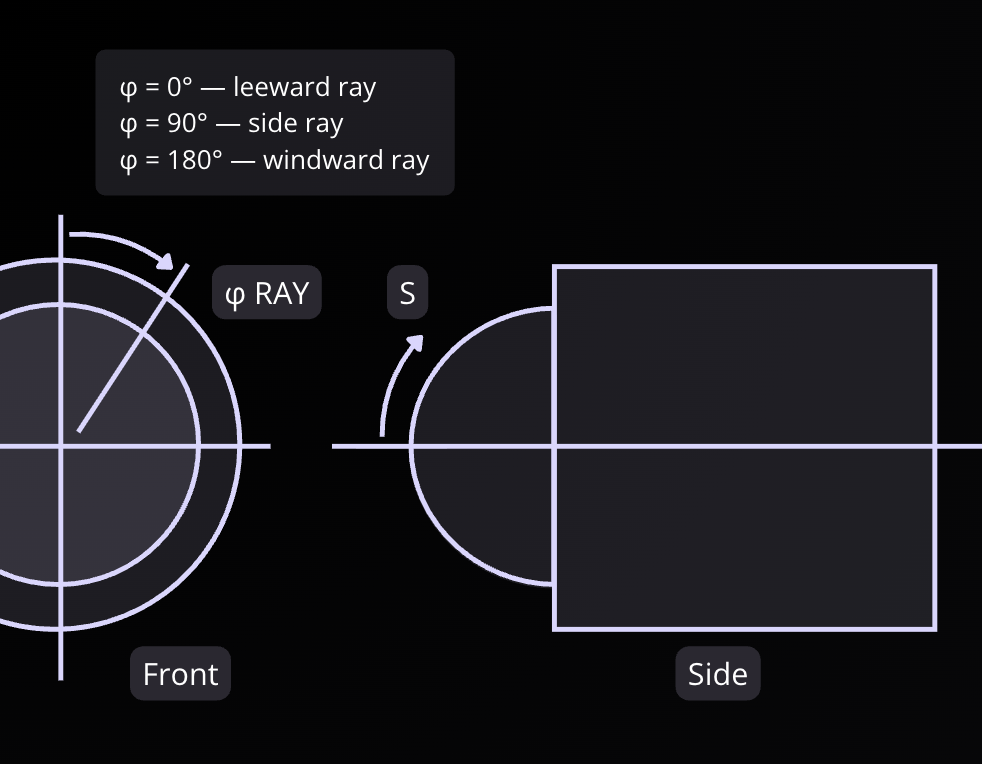
Surface pressure is normalized by freestream pressure (p/p∞) and extracted along three circumferential rays measured from the windward stagnation line:
φ = 0° — leeward ray
φ = 90° — side ray
φ = 180° — windward ray
Each ray is plotted against arc length S (inches) along the dome surface, and overlaid against the Huebner experimental points and the ANSYS Fluent prediction at the same conditions.
Results
At 10° angle of attack the aerospike is no longer a pure drag/heat-load reducer — it actively hurts the windward side of the dome. The aerospike-induced separation shock impinges on the windward surface, and Huebner showed experimentally that the resulting peak pressure can exceed the bare-dome stagnation pressure. Capturing this peak is the real test for any solver in this regime.
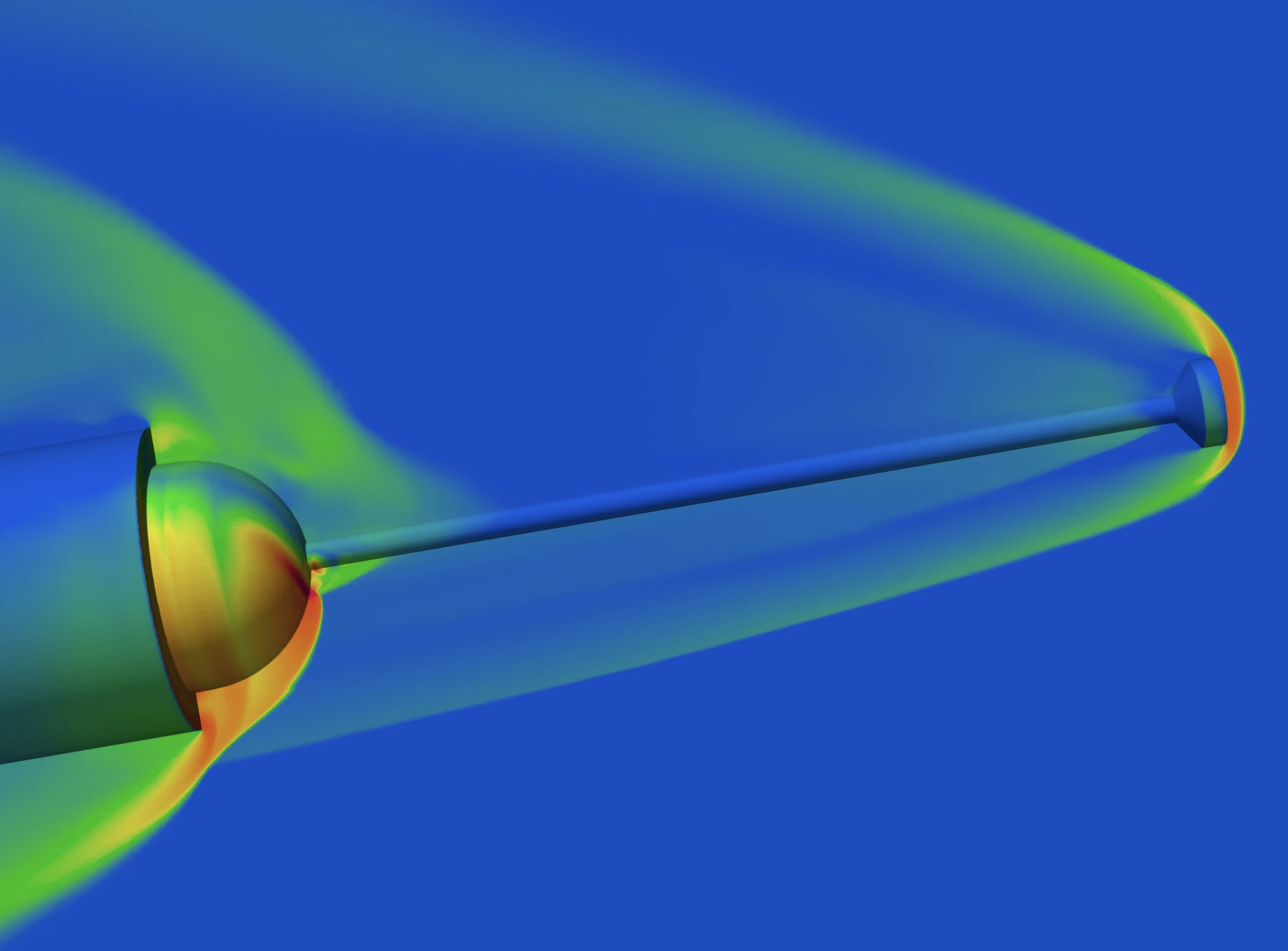
The pressure contour image shows the structure that drives the curves: the bow shock standing off the aerodisk, the long recirculation tube along the spike shaft, and two intense compression regions — one at the aerodisk tip and one where the shock system reattaches on the windward dome. That second region is the source of the windward peak.
The blastFoam results reproduce the key features of the experiment:
Windward (φ = 180°): the strong shock-impingement pressure peak near S ≈ 0.5 in. is captured, with magnitude in line with the Fluent reference and the experimental envelope. Both CFD codes slightly over-predict the peak relative to the experimental measurement at that location, consistent with shock-resolution sensitivity on the coarse mesh.
Side (φ = 90°): the secondary pressure rise around S ≈ 0.7–0.8 in. is well placed, with blastFoam tracking both the experimental trend and the Fluent solution through the relaxation toward the body.
Leeward (φ = 0°): the dome sits in the recirculation/wake region and the surface pressure stays low and flat — also captured well.
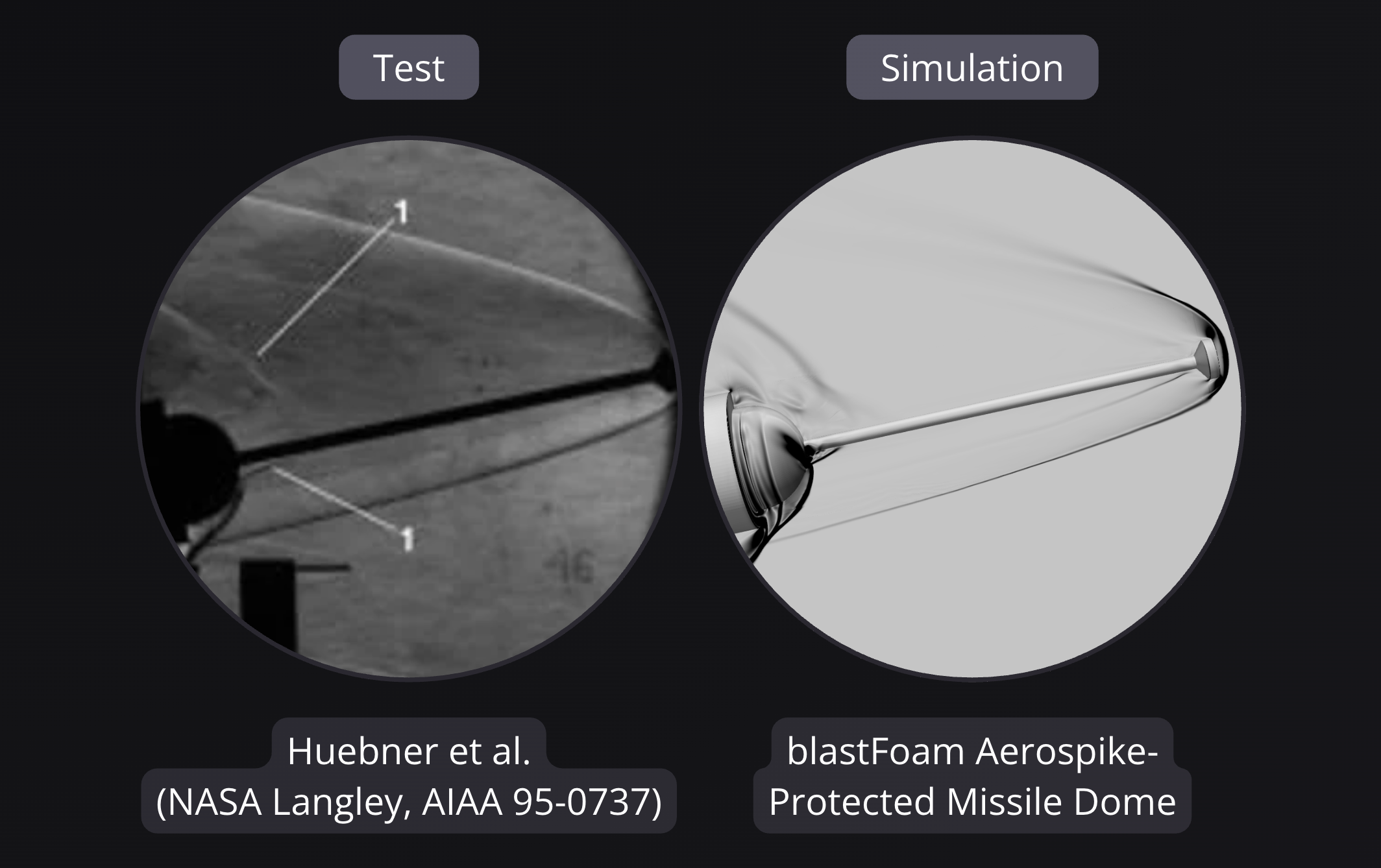
blastFoam vs. Experiment & ANSYS Fluent at Mach 6
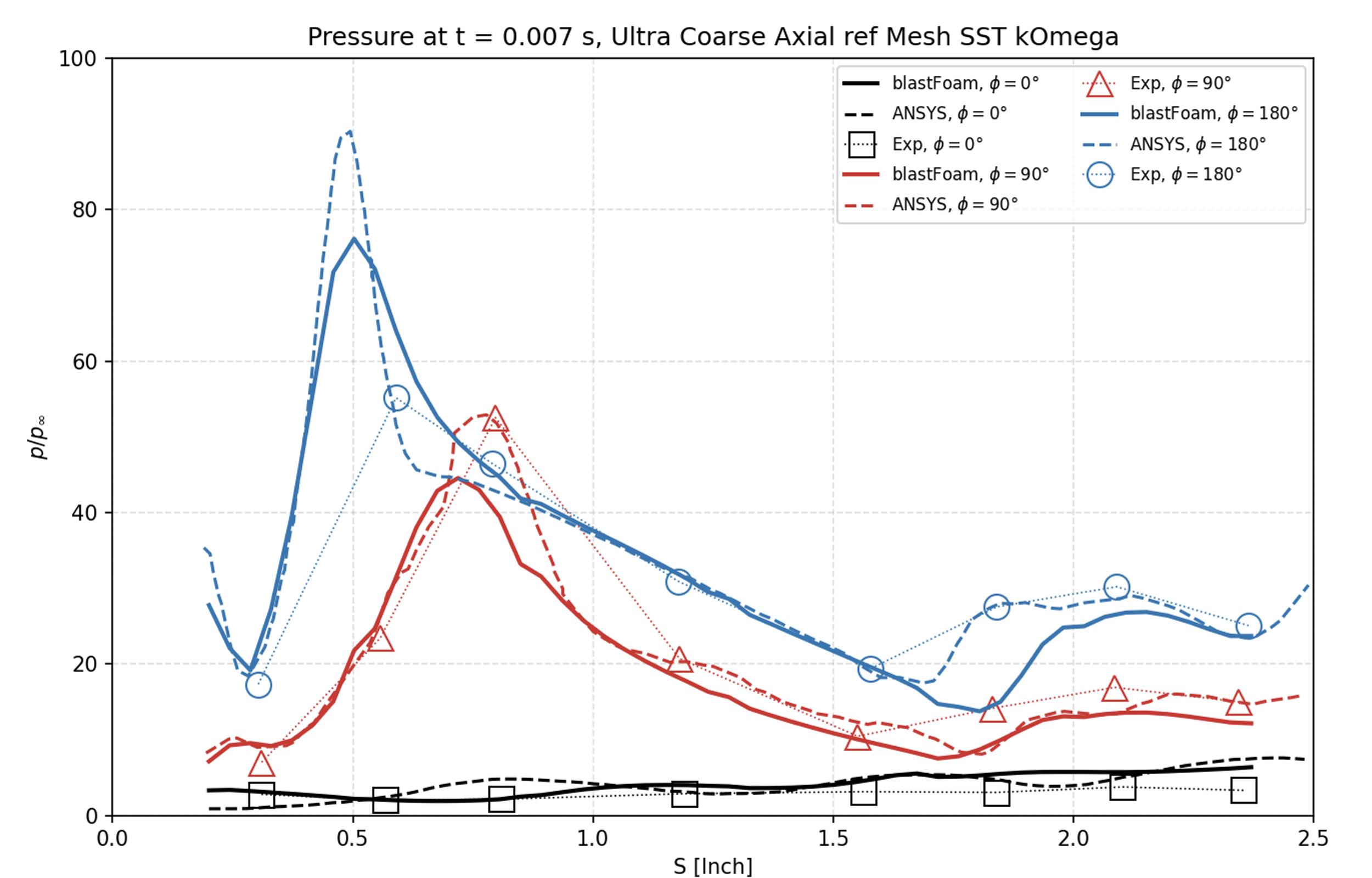
Pressure at t = 0.007 s, Ultra Coarse Axial ref Mesh SST kOmega
Takeaways
blastFoam with k-ω SST reproduces the experimentally observed loss of aerospike effectiveness at moderate angle of attack, including the correct location and approximate magnitude of the windward shock-impingement peak.
Agreement with the published Fluent solution is strong across all three rays, supporting blastFoam as a credible open-source option for this class of high-speed external aerodynamics problem.